
Springfield City Directory Collection Shelf
Springfield city-directory research begins with Springfield and Lane County shelves, not a complete annual series. The Springfield Public Library Local History & Genealogy guide points Springfield researchers to genealogy books, newspaper routes, linked family-history services, museum contacts, the Oregon State Archives, and Springfield Times microfilm at the University of Oregon. The documented Springfield and Lane directory runs start in 1873 and continue discontinuously through the twentieth century. The Oregon Genealogical Society, University of Oregon, and archival collections are the practical places to ask for the particular Springfield Polk, Korstad, or Salisbury volume needed. A returned catalog result is only a lead. Read or obtain the original page before treating any Springfield spelling, address, or notation as settled.
| Collection | Years | Where Held | Access |
|---|---|---|---|
| Documented Springfield and Lane directories | 1873 onward, discontinuously documented | OGS, University of Oregon, and Springfield archival collections | Ask for the identified Springfield volume or scan; confirm the original page. |
| Springfield Register-Guard archive route | 1867-2001 | Springfield Library archive referral | Search a name and date for Springfield address, obituary, social, or probate context. |
| Springfield Register-Guard text | 2001-present | Springfield Public Library database | Use under the Springfield library's access conditions. |
| Springfield Times microfilm | Years not stated in the public guide | University of Oregon | Ask the university about the Springfield run and reader access. |
For Springfield archival volumes, the useful question is often which Springfield copy survives, rather than where a master index sits. The Springfield Library guide is the first referral point, while the OGS library and University of Oregon supply a deeper shelf-and-microfilm route when a local keyword search runs out.
Springfield City Directory Years
The known chronology gives a precise request list for Springfield city-directory work. John Mortimer Murphy's Oregon Business Directory State Gazetteer is documented for 1873. Obenauer's Directory Eugene and Lane County follows in 1892-93. Polk volumes are documented for 1901-02, 1907, 1911, and 1912, with the 1912 Polk's Eugene City and Lane Directory explicitly including Springfield. The later Polk Eugene and Lane County volumes appear in several, not every, year. A separate 1934 Korstad directory and the 1945 and 1947 Springfield-area Salisbury volumes widen the shelf. Use these Springfield dates as a volume checklist, not as proof that every household appeared in each publication.
- 1873: Murphy's Oregon business directory and state gazetteer for the Springfield-area era.
- 1892-93: Obenauer's Eugene and Lane County directory, a lead for early Springfield research.
- 1901-12: Polk's documented 1901-02, 1907, 1911, and Springfield-inclusive 1912 volumes.
- 1921-41: Polk's Eugene and Lane County volumes for 1921, 1925, 1928, 1931, 1934, 1936, 1937, 1940, and 1941.
- 1934: Korstad's Eugene-Lane County Oregon directory for Springfield-area checking.
- 1945 and 1947: T. W. Salisbury Eugene-Springfield-Cottage Grove and Lane County directories.
The 1945 Salisbury volume is especially useful because its documented structure includes Springfield, a street guide, reverse telephone material, classified listings, and separate Eugene and rural sections. Those Springfield sections can point in different directions, so record which section supplied a Springfield result.
Note: A documented year identifies a collection lead, not a guarantee that a particular person, address, or abbreviation appears in that volume.
Springfield City Directory Library Routes
The Springfield Library guide brings Springfield directory research together with newspapers, obituaries, genealogy books, and archive referrals. Its reference phone is 541-726-3766, with answers during Tuesday through Saturday open hours. That makes it a sensible first contact when the needed item may be in Springfield Times microfilm, the Register-Guard archive, or a linked Springfield collection. The University of Oregon's historic-newspaper guide gives Springfield researchers another route to the Eugene Register-Guard, listed there from 1867 through 2008. University Special Collections uses the Paulson Reading Room in Knight Library and asks researchers to request material at least five business days ahead.
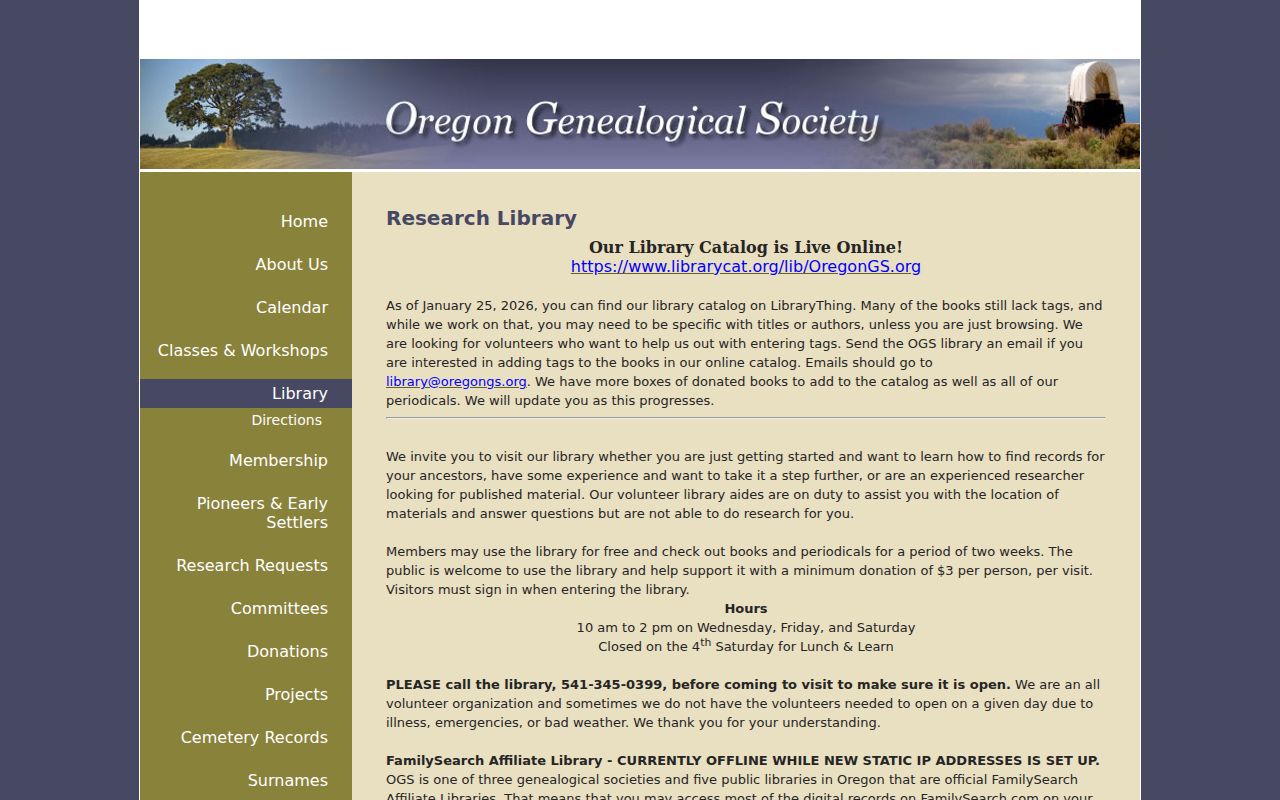
The Oregon Genealogical Society Research Library holds more than 10,000 books, periodicals, maps, microfilm, microfiche, CDs, and vertical files, including family histories and Oregon county material. It publishes a $3 visitor contribution after sign-in, Wednesday, Friday, and Saturday hours of 10 a.m. to 2 p.m., and 541-345-0399 for a call before Springfield-area travel. Its online catalog moved to LibraryThing in January 2026 and is described as incomplete, so a catalog miss is a reason to ask or visit rather than declare a Springfield directory absent.
OGS's published library page shows the local research setting before a collection request.
For a remote search, OGS research requests expressly include city directories and obituaries. The posted charge is $20 per hour for nonmembers or $15 for members, with a one-hour minimum. Give name variants, an approximate date and place, and the record category requested.
Reading Springfield City Directory Entries
Do not reconstruct a Springfield sample entry from a generic directory pattern. No safely reproducible Springfield entry page and abbreviation key were captured for this research pass. Instead, treat the original Springfield page as the authority and inventory only the fields it actually prints. An entry may identify a householder, a spouse notation, an occupation or employer, a street address, a status mark, a widow notation, a cross street, or telephone information. Any of those details can be absent, abbreviated, or arranged differently by Springfield publisher and year. Photograph or transcribe the volume's own abbreviation key before expanding a mark.
| Householder name | Copy the exact spelling, initials, and ordering from the volume. |
|---|---|
| Family notation | Record a spouse or widow notation only if the entry actually prints it. |
| Work detail | Keep an occupation or employer as printed, including abbreviations pending the key. |
| Place detail | Copy the street address, cross street, or telephone information without modernizing it. |
| Status mark | Interpret a symbol only from that volume's own key. |
- Criss-cross directory
- A street-order section, when a volume includes one, that organizes listings by address rather than name.
- Householder index
- A name-oriented listing for the household contact named by the publisher, not a complete list of everyone at an address.
- Abbreviation key
- The publisher's explanation of shortened words and symbols; it is needed before expanding a notation.
When a historical name later needs a present-day record check, use a focused Springfield resident lookup rather than treating an old directory entry as current confirmation.
Trace Springfield City Directory Households
Springfield family-history work is strongest when the Springfield city-directory result is treated as one dated observation. Begin with the closest documented Springfield volume, then look through adjacent available years for altered initials, spelling changes, or a new householder at the same address. Where a confirmed volume has a reverse or criss-cross section, compare the street-order listing separately. The next released federal census may add household members, age, relationship, occupation, and property context. Federal schedules are currently available through 1950. A Springfield deed, plat, or newspaper item can then test whether an apparent move was a change of address, a change of ownership, or a change in the way the source described the place.
- Choose the volume nearest the known event and copy the entry exactly.
- Check the next available directories for spelling, initial, address, and householder changes.
- Use a reverse or criss-cross section only when the confirmed volume contains one.
- Pair the closest directory year with the nearest released federal census.
- Compare the dated address with a deed, plat, newspaper, or archive record before drawing a conclusion.
A Springfield disappearance may reflect a move, death, changed household head, publisher omission, or a rural-versus-city boundary change. It does not prove that the person was absent from Springfield.
Springfield Directories and Newspapers
Springfield newspapers provide the date layer that many Springfield directories lack. The Springfield Library guide places Register-Guard text from 2001 forward alongside an archive route for 1867-2001, and it refers researchers to Springfield Times microfilm at the University of Oregon. A dated Springfield notice can associate a person with a school, club, street, social event, business, probate matter, or obituary, but it still needs source and date verification. For a Springfield obituary, begin at the death date and scan roughly seven days forward. Remote researchers can ask Springfield Library staff to search when they provide a full name, death date and place, and contact details.
Use a newspaper result to test a directory clue, not to overwrite it. Names in older clippings may be abbreviated, misspelled, or refer to a relative. Keep the publication date and page reference with the directory year.
Note: A newspaper mention can strengthen a time-and-place trail, but it does not establish continuous residence between the dated sources.
Springfield Washburne Directory Clues
The historic Washburne district gives Springfield city-directory research a place-specific companion route. The Library guide directs researchers studying a residence there to its planning-information channel for architectural style, photographs, and other historic material. It also identifies the Springfield History Museum photograph collection, vertical research files, and research library. The district's documented buildings from the 1890s through the 1940s make it a promising area for a careful combination of a directory, county deed, historic photograph, and dated newspaper item. That method stays tied to the individual property and record date, rather than treating a neighborhood history as a roster of later residents.
The Springfield History Museum collection page is the source for the local museum research route.
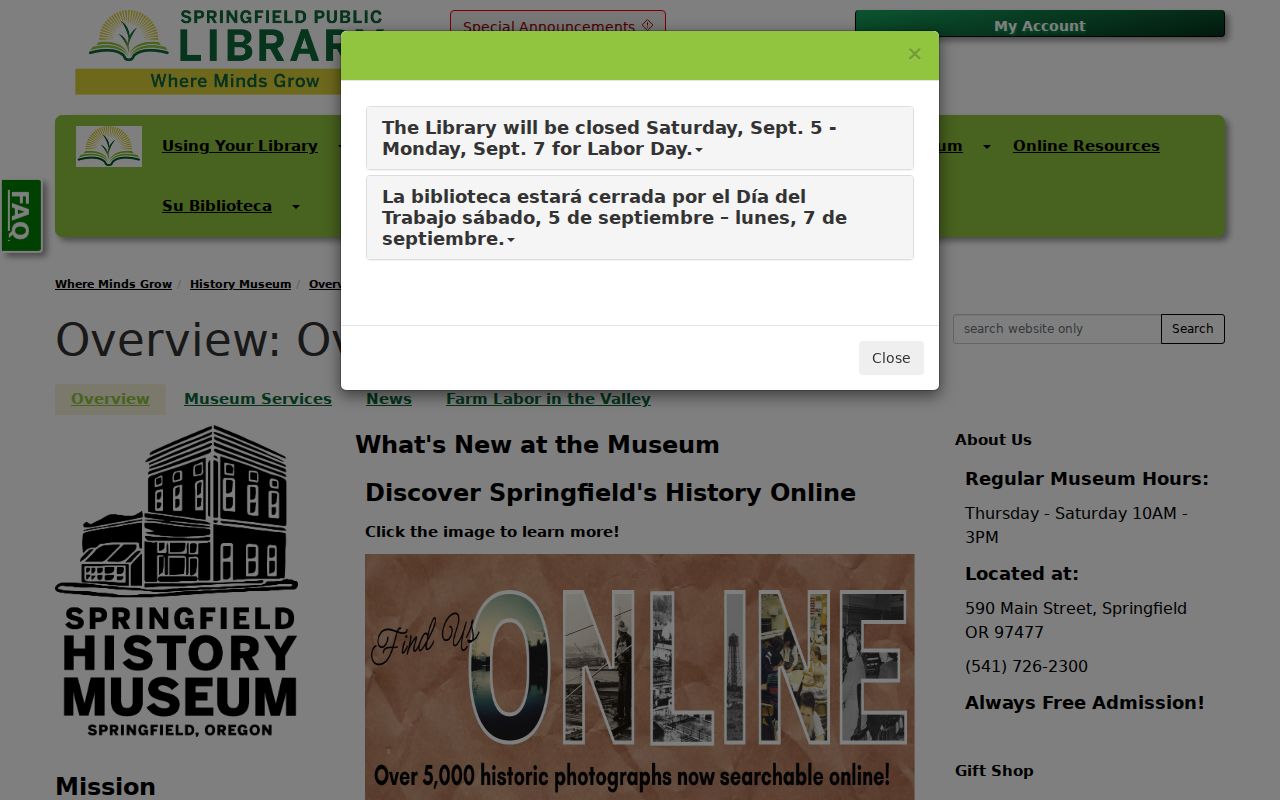
The Museum reports that item descriptions, rights, digitization, and access require checking with the collection. Its FY 2026 work included a historic-photograph database project, which improves discovery without making every item online or public. Curator research requests are another documented channel for the photograph and vertical-file material.
Springfield City Directory Timeline
Springfield's changing physical record system explains why directory reading must be date-conscious. Springfield was settled in 1848, platted in 1856, incorporated in 1885, and chartered in 1893. The earliest Springfield descriptions can use lot, block, ferry, mill, or township wording instead of a current formatted street address. Later Springfield postwar growth changed the city again. Lane County's recordkeeping also divides into access eras: older deed books and grantor-grantee indexes remain physical or microfilm resources, while the computer index begins in 1972 and computer images in 1994. A Springfield directory address should therefore be matched to the Springfield record system that existed at its date.
The 1856 Springfield original plat used lots 66 by 120 feet with 66-foot streets. That local detail helps explain why a central Springfield source may identify a block and lot rather than a modern street number.
Springfield Directory Family Leads
When a Springfield city-directory trail reaches an estate, marriage, divorce, or census question, the State Archives adds a distinct historical channel. The Oregon Historical Records Index lists Lane estates from 1852-1937, guardianships from 1853-1937, and divorces from 1855-1900. Lane marriage indexes reach 1853-1950, while the underlying marriage records cited in the research cover 1852-1891. These are index leads, not full household histories. Follow an index hit to the identified archive or court source, and preserve the record type and date when relating it to a directory address.
The Oregon State Archives Lane inventory also describes court, deed, probate, military, and census holdings. FamilySearch trees can be useful clues through the Library guide, but county, archive, court, or original-image evidence should confirm the connection. This broader check is particularly useful for family questions where a directory name may be shared by several people.
Springfield City Directory Limits
Historical directories are selective publications. They can omit a household, use an initial, change a street label, place a person in a rural or separate section, or record a business contact instead of a residence. Reverse telephone material in the 1945 Salisbury volume is useful only after its original entry is checked, and it cannot establish who lived at an address outside that source date. The Library, OGS, Museum, University, and State Archives provide complementary access channels because no one shelf supplies a complete Springfield historical directory.