
Find Springfield Previous Residents Sources
Previous residents of a Springfield address are best traced era by era. County systems make a good modern start, but the online index and document-image dates are not the beginning of the local record trail. Earlier Lane records are held through the Deeds and Records Research Library and archival routes. A directory or census result is useful for a dated household clue, while a deed supplies a recorded conveyance. Combining them gives a more honest history than treating one source as a complete list of every past resident.
| Source | Years It Covers | Where Held | What It Shows |
|---|---|---|---|
| Computerized official filings index | 1972-present | Lane Deeds and Records system and research library | Named recorded documents and filing data. |
| Computer document images | 1994-present | Lane Deeds and Records system | Available images of recorded documents. |
| Grantor-grantee index | 1902-1970 | Deeds and Records Research Library | Indexed parties for deeds, mortgages, and related entries. |
| Grantor-grantee microfiche | 1971-1979; 1980-1998 | Research library and Deeds and Records Office | Transition-period party indexes. |
| Deed books | 1854-1952 | Deeds and Records Research Library | Early conveyances and legal descriptions. |
| Released federal census | Through 1950 | National Archives and genealogy channels | Household details at the census date, not yearly residence. |
| Springfield and Lane directories | 1873 onward, discontinuously documented | OGS, University of Oregon, and archival collections | Named and address clues in confirmed volumes. |
Begin with the date range you need. A post-1994 transfer may be visible with its image online. A 1920s deed needs the microfilm or book route, then a checked directory or census source for the household layer.
Springfield Past Resident Era Breaks
The Oregon State Archives Lane County records inventory makes the change in research method clear. Lane’s computer index starts in 1972. Images begin in 1994. The research library’s grantor-grantee microfilm covers 1902 through 1970, while microfiche bridges 1971 through 1979 and office microfiche covers 1980 through 1998. Deed Book A through W and volumes 24 through 461 begin in 1854. The archive is therefore a distinct historical route, not simply a backup for an online search.
The official State Archives inventory documents the record groups used to move a Springfield past-address search across those eras.
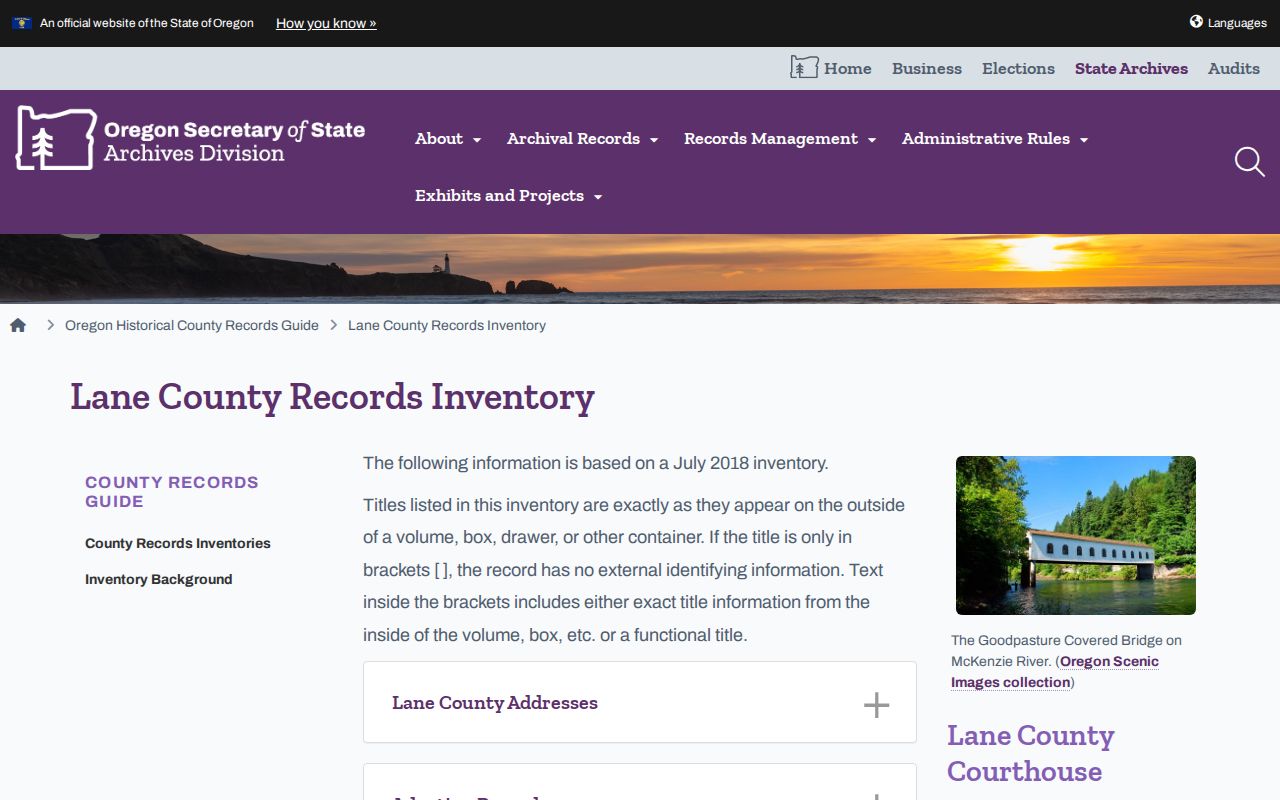
Its coverage descriptions help select the index, microfiche, or deed-book channel that matches the document date. The inventory also describes official filings as a 1952-ongoing series with filing date, transaction description, filing number, names, assessed amounts, and sometimes subdivision or lot details. Those fields can help test whether a later record concerns the same Springfield parcel.
Subdivision references run from 1856 forward, subdivision plats from 1891 forward, and partition plats from 1975 forward. Those records can translate a current address into the lot, block, or subdivision wording found in an older deed.
Trace Springfield Past-Owner Records
Ownership is the first layer of a past-resident trail. Use Lane County Property Account Information or the county property tools to identify the current account, map tax lot, situs, and owner of record. Then use RLID Deeds and Records to locate the current transfer by party, date, document type, document number, or maplot when the field is available. The result should be treated as a record lead. A recorded owner, trustee, lender, or estate party is not automatically a person who lived at the address.
- Save the current address, account number, map tax lot, and legal description from the property result.
- Find the latest deed or conveyance and copy its grantor, grantee, recording date, instrument number, and legal description.
- Search the prior grantor as grantee around the earlier purchase, then compare the legal description and dates.
- Repeat the backward search for each confirmed transfer, recording any address form used by that document.
- When the web index period ends, shift to the microfilm, microfiche, or deed books at the research library.
The Lane County Clerk’s recording counter and research library are at 125 E. 8th Ave., Eugene. The Clerk lists weekday research hours of 9 a.m. to noon and 1 p.m. to 4 p.m.; call 541-682-3654 through the Clerk’s official page before a visit.
Springfield Address Record Terms
These terms keep an ownership chain distinct from a household history. Old deeds can omit a modern street number, which is why the legal description and plat reference matter. The same care prevents a directory entry from being read as proof of a complete household through every year.
- Grantor
- The party transferring an interest in a recorded document.
- Grantee
- The party receiving that interest in the document.
- Chain of title
- The sequence of recorded transfers for a parcel, checked through dates and legal descriptions.
- Legal description
- The lot, block, subdivision, or survey wording that identifies land more reliably than an old street number.
- Criss-cross directory
- An address-arranged section in a directory volume, when that volume includes one.
Note: A matching surname is only a lead until the parcel description, source date, and document role also line up.
Springfield Past Resident Plat Clues
Springfield was platted in 1856, so the older part of a historical address search may turn on a lot and block rather than a familiar street number. The original town plan used 66-by-120-foot lots and 66-foot streets. The Washburne historic district, roughly 34 blocks between 2nd and 10th Streets and B through H Streets, holds buildings from the 1890s through the 1940s. That local geography can make a plat, a recorded deed, a photograph, and a dated newspaper item work together.
No verified citywide street-renumbering date was found in the research. Confirm a rename, annexation, or address equivalence with the relevant plat and dated city or county source instead of assuming that today’s number appeared in the old document.
Springfield Past Household Directory Pairing
Directories and census schedules add the household layer that deeds can miss. Springfield and Lane city directories are documented from 1873 onward, but not as a continuous annual run. Confirm the original volume before transcribing an entry. The 1945 Salisbury directory, for example, had separate street-guide, Springfield, reverse-telephone, and classified sections. A criss-cross route should be used only after confirming that the particular volume has one. The collections and their access channels are kept in the Springfield Directory Book.
- Place each confirmed transfer or address form on a simple date list.
- Check nearby confirmed directory years for the exact name, initials, and address wording.
- Pair the address with the nearest released federal census, now through 1950.
- Compare household members, age, relationship, and property context without assuming annual continuity.
- Test a change against a deed, plat, obituary, or dated newspaper item before declaring a move.
The 1950 endpoint matters. A federal census reports one enumeration date, while a directory can be incomplete, use initials, or reflect a publisher’s coverage boundary. A missing entry is not proof of absence.
Springfield Historical Museum Records
For a historic Washburne address, the Springfield Public Library Local History and Genealogy guide directs researchers to City Planning staff for architectural and historic information. It also identifies the Springfield Museum photograph collection, vertical files, and research library. This is a place-specific route for a house history, especially when a deed has a legal description but no clear modern address.
The Lane County History Museum research library and archives add maps, photographs, and regional context that do not appear in a recording index.
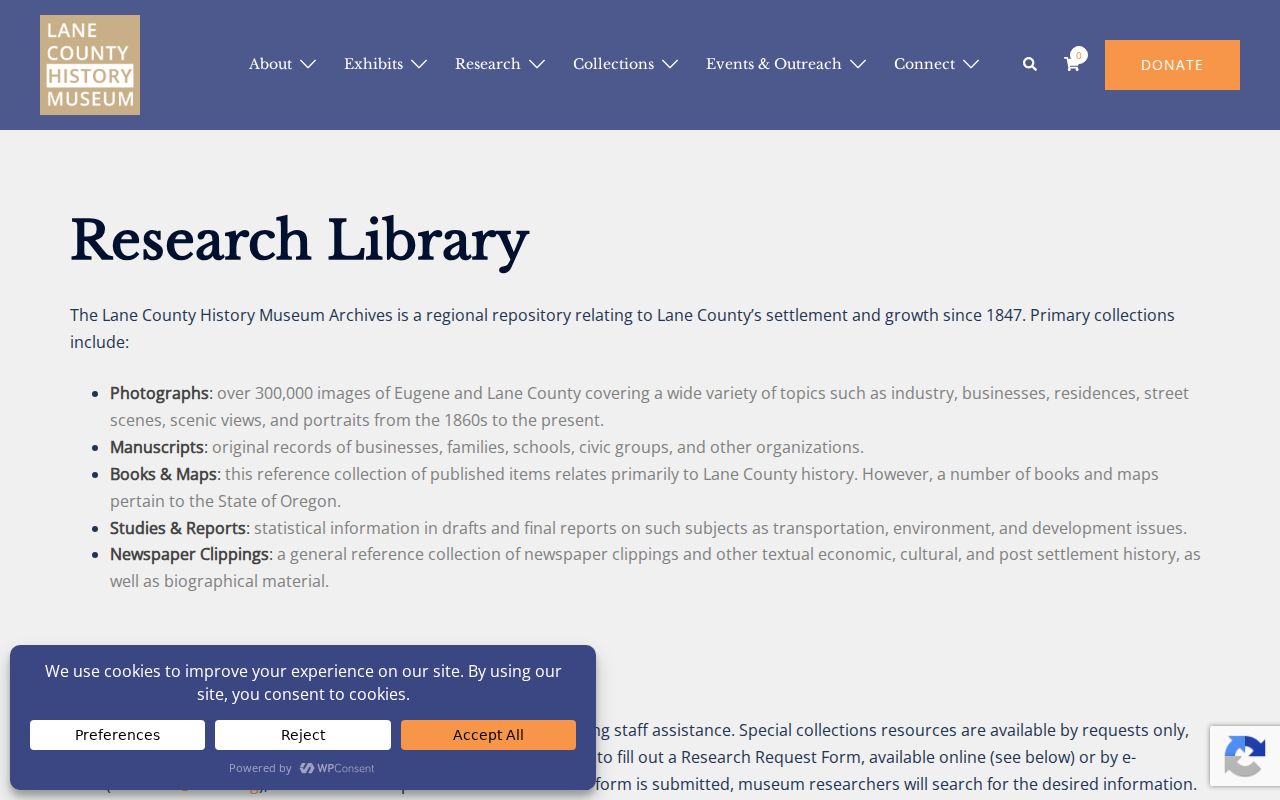
Museum material can support a dated place history, but it does not replace a documented ownership or household record.
The Springfield guide lists curator research contact and a reference phone, 541-726-3766, for library questions. A focused request with an address, approximate date, and record type gives staff a usable starting point.
Springfield Past Resident Newspaper Trail
The local newspaper route can help close or test a past household timeline. The library guide points to Register-Guard text from 2001 forward and an archive for 1867 through 2001. It also refers readers to Springfield Times microfilm at the University of Oregon. For an obituary, begin on the death date and look roughly seven days forward. Preserve the date and publication because a short notice can use initials, a married name, or a relative’s address.
Historical estate and probate research has a separate official starting point. The Oregon Historical Records Index lists Lane estates from 1852 through 1937, alongside other indexed record groups. An index hit is a lead to the named archive or court custodian, not a substitute for the underlying file.
University of Oregon Special Collections is another local route for archival material. Its Paulson Reading Room asks researchers to request material at least five business days ahead. That access step is useful when a library referral points beyond a digitized newspaper or directory.
Springfield Past Resident Use Limits
Historical address research is suited to family history, a property’s recorded past, an estate question, or local history. It must remain date-specific. A record can be incomplete, misspelled, or attached to a mailing address that differs from the property. Oregon confidentiality rules can also limit access to voter, motor-vehicle, vital, and protected-address information. Do not try to fill those gaps by combining fragments from unrelated sources.
Lawful use. Use Springfield past-resident records for personal, family-history, property, or civic research. Never use a record trail to stalk, harass, threaten, or harm a living person.
Oregon’s anti-stalking statutes are ORS 163.730 through 163.755, and its harassment statute is ORS 166.065. The practical standard is simple: verify a historical fact with the custodian and respect information that the law keeps private. If a result is unclear, retain the source date and contact the office that maintains the original record rather than relying on an unattributed copy. A careful past-address history leaves its uncertain links labeled as uncertain and does not turn a lead into a claim.